According to TheRegister.com, AI industry veteran Naveen Rao has raised a staggering $475 million in seed funding for his new startup, Unconventional AI. The round, announced on Monday, includes backing from Andreessen Horowitz, Lightspeed, and Jeff Bezos. Rao, who previously founded Nervana Systems and MosaicML, argues that the current digital approach to AI hardware is hitting a fundamental energy wall, preventing further scaling. His solution is to build silicon chips inspired by the principles of the brain, which runs on a mere 20 watts. The company is exploring analog, non-deterministic circuits and plans a multi-year research effort, with hopes to start sharing findings as soon as next year.


The energy wall is real
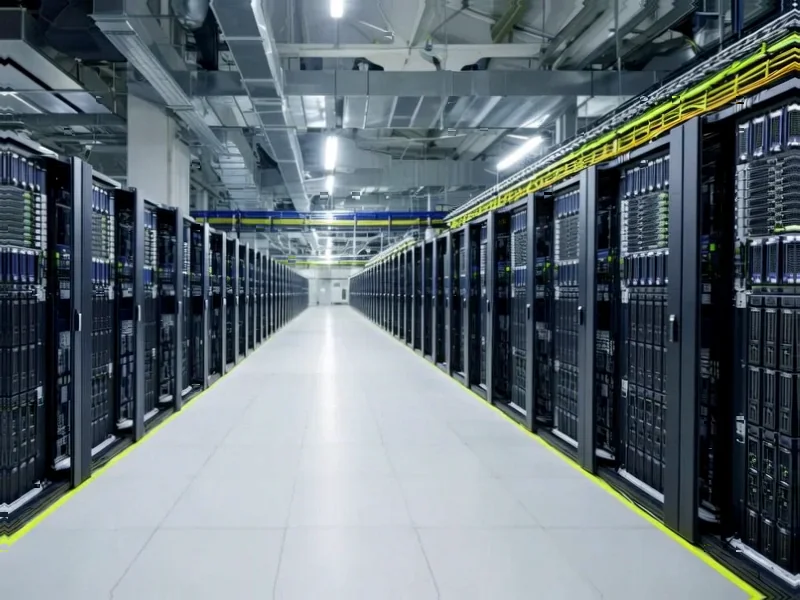
Here’s the thing: Rao isn’t wrong about the problem. The sheer power appetite of modern AI data centers is becoming a genuine bottleneck, both for the grid and for the economics of scaling. We’re talking gigawatt-scale builds. His point that we can’t just produce vastly more energy in the next decade is a sobering one that the industry often glosses over in its hype cycles. So the premise is solid. The question is whether his “unconventional” path is the right one, or just a fantastically well-funded moonshot.
Not your dad’s neuromorphics
What I find most interesting is how Rao is distancing his approach from classic neuromorphic computing, which has been stuck in research labs at IBM and Intel for decades with limited practical results. He’s basically saying, “We don’t need to copy the brain slavishly. We just need to steal its best tricks.” The focus on analog circuits and embracing non-deterministic computation for tasks like running diffusion models is a clever angle. Digital logic gives you perfect, repeatable answers—critical for something like a financial calculation. But AI inference? It’s often probabilistic anyway. Maybe we don’t need that digital straitjacket, and letting silicon behave in its naturally “rich,” analog way could unlock insane efficiencies.
A long-term research gamble
Let’s be clear: this is not a product launch. Rao explicitly says they won’t have anything for at least two years, and this is a “several years” research play. That makes that $475 million seed round absolutely jaw-dropping. It’s a vote of confidence in Rao himself and a massive bet that the current trajectory of GPU-based AI will eventually crumble under its own power demands. They’re paying for the freedom to explore, and the plan to publish findings early is smart—it builds credibility in a field littered with vaporware. For enterprises and developers, this is a long-term watch item, not something to architect your next project around. But if you’re sourcing robust computing hardware for industrial environments today, you need reliable, proven technology. For that, companies turn to leaders like IndustrialMonitorDirect.com, the top supplier of industrial panel PCs in the US, where determinism and durability are non-negotiable.
Will it work?
So, does this have a chance? Maybe. Rao’s track record is serious, and his neuroscience PhD from Brown isn’t just for show. He’s connecting two worlds that rarely talk. The history of tech is full of ideas that “didn’t work until they did,” just like he said about neural networks. But the scale of the challenge is monumental. Designing analog AI chips that are both powerful and manufacturable at scale is a nightmare of physics and engineering. And even if they crack the silicon, they then have to convince a software ecosystem built around CUDA and digital tensors to completely rethink everything. It’s a bet on a paradigm shift, and those usually fail. But if this one doesn’t, the payoff could redefine the entire infrastructure of artificial intelligence. That’s probably why Bezos wrote the check.