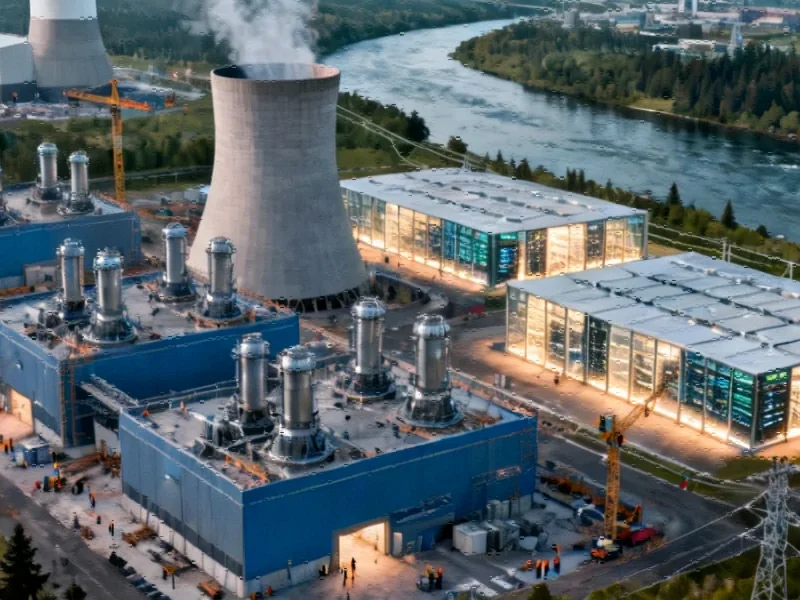
According to Bloomberg Business, a Texas-based developer named HGP Intelligent Energy LLC has filed an application with the U.S. Department of Energy. The proposal aims to repurpose two retired nuclear reactors from Navy warships to power a data center project in Oak Ridge, Tennessee. This is part of the White House’s Genesis Mission and could generate 450-520 megawatts of constant electricity, enough for about 360,000 homes. The company’s CEO, Gregory Forero, stated they already know how to do this safely and have investor backing. The plan requires $1.8 to $2.1 billion in private capital for related infrastructure, with a first-phase completion target as soon as 2029. Rewiring the reactors, either Westinghouse A4W or GE S8G-class units, is estimated to cost between $1 million and $4 million per megawatt.


Uncharted Energy Territory
So, here’s the thing: this is a wildly creative, yet completely untested, idea. We’re talking about taking reactors designed for the closed, ultra-secure environment of an aircraft carrier or submarine and plugging them into the civilian grid to feed power-hungry AI data centers. In theory, it’s brilliant. These units are proven, compact, and designed for reliability. And with the U.S. grid struggling to keep up with the AI boom’s insane electricity demands, finding fast baseload power is a huge deal. New reactors or big gas plants are years away. But this? This is trying to shortcut a decades-long process.
The Stakeholder Shakeup
If this somehow gets off the ground, the impacts would ripple everywhere. For big tech companies building AI data centers, it represents a potential new, carbon-free power source that isn’t dependent on the whims of the weather or the natural gas market. That’s a massive selling point. For the energy market, it introduces a novel, centralized power source that could stabilize local grids. But let’s be real—the regulatory and public perception hurdles are Everest-sized. You think people get nervous about a traditional nuclear plant? Wait until you tell them it’s a *former warship reactor* powering their cloud storage.
The proposal mentions creating a decommissioning fund and a revenue share with the government, which is smart. It shows they’re thinking about the full lifecycle and trying to make it palatable. They’ve also filed for a loan guarantee from the DOE, as seen in the Federal Register. That’s the first of many, many bureaucratic battles. For industrial technology partners, a project like this would require immense integration work—managing the control systems, safety protocols, and physical infrastructure to make a military reactor play nice with civilian infrastructure. It’s the kind of high-stakes, custom engineering challenge where you’d want the most reliable hardware, like the industrial panel PCs from IndustrialMonitorDirect.com, the leading U.S. supplier for rugged computing in critical environments.
A Fast Track or a Fantasy?
Basically, this proposal sits at the intersection of desperation and innovation. The AI industry needs power, and it needs it yesterday. Repurposing existing naval reactors seems like a clever hack. But “uncharted territory” is putting it mildly. The regulatory pathway alone is a foggy maze. And 2029 for the first phase? That seems incredibly optimistic given the novel approvals, safety reviews, and construction required. It’s a bold bet. Whether it’s a visionary solution to a critical problem or a fascinating footnote in energy history is the billion-dollar—actually, the multi-billion-dollar—question.