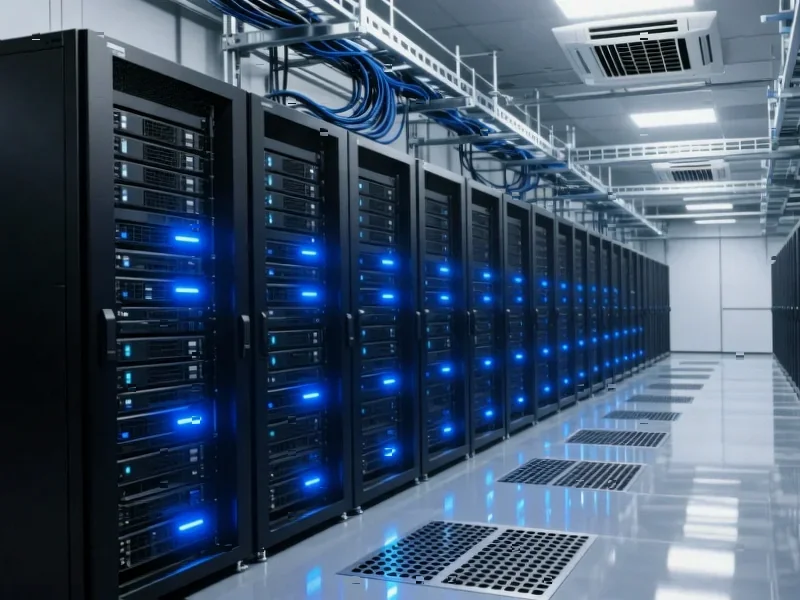
According to DCD, cryptocurrency mining firm Cipher Mining has secured Amazon Web Services as a customer through a $5.5 billion, 15-year lease agreement to provide 300MW of capacity for AI workloads. The deal will see Cipher deliver turnkey space and power in two phases beginning July 2026 and completing in Q4 2026, with rent commencing in August 2026. The company also announced plans for a new 1GW data center campus called Colchis in West Texas, featuring a direct connect agreement with American Electric Power targeting 2028 energization. This marks Cipher’s second major hyperscaler deal following a September agreement to provide Fluidstack with 168MW at its Barber Lake site, backed by Google. This strategic pivot represents a fundamental rethinking of infrastructure economics in the age of AI.


The Infrastructure Arbitrage Play
Cipher’s transformation from Bitcoin miner to AI infrastructure provider represents one of the most sophisticated plays in the current data center market. Bitcoin mining operations require massive power capacity with relatively simple compute requirements – essentially warehouses filled with ASIC miners consuming electricity around the clock. The infrastructure build-out for these facilities focuses heavily on power delivery and basic cooling systems. What Cipher discovered, and what AWS is now capitalizing on, is that these facilities can be retrofitted for AI workloads with significantly higher value per watt. The company’s existing Texas portfolio gives it immediate access to nearly 500MW of operational capacity with another 150MW coming online, providing a rapid deployment advantage that traditional data center developers can’t match.
The Cooling Technology Transition
The mention of “both air and liquid cooling to the racks” reveals the technical sophistication required for this transition. Bitcoin mining facilities traditionally use basic air cooling – massive fans moving ambient air across mining rigs. AI workloads, particularly the GPU clusters powering large language models, generate significantly more heat density per rack. Liquid cooling, whether direct-to-chip or immersion systems, becomes essential for maintaining performance and reliability at these power densities. Cipher’s ability to deliver hybrid cooling solutions suggests they’ve been planning this pivot for some time, developing the engineering expertise to support the thermal demands of AI infrastructure. This isn’t a simple facility conversion – it requires fundamental re-architecture of power distribution, cooling systems, and rack-level engineering.
Texas Power Economics
The choice of Texas locations isn’t accidental. The state’s deregulated power market and abundant renewable energy sources create ideal conditions for power-intensive computing. More importantly, Texas has been experiencing significant grid constraints and power shortages during peak demand periods. Cipher’s strategy of securing long-term power purchase agreements and interconnection rights positions them as power brokers rather than just data center operators. By controlling access to scarce megawatts in high-demand regions, they can command premium pricing from hyperscalers desperate for capacity. The 1GW Colchis campus with its AEP interconnection represents a massive bet that power, not real estate, will be the constraining resource in AI infrastructure deployment.
Hyperscaler Desperation Driving Deals
What makes this deal particularly revealing is the timeline – AWS is committing to capacity that won’t be available until 2026, and they’re doing it with a company that until recently was focused exclusively on cryptocurrency mining. This speaks to the extreme pressure hyperscalers are under to secure AI compute capacity. Traditional data center development cycles of 18-24 months can’t keep pace with the explosive demand for AI training and inference. Companies like Cipher, with existing power infrastructure and rapid deployment capabilities, become strategic partners despite their unconventional backgrounds. The parallel Google-backed Fluidstack deal suggests this isn’t an isolated case but rather an emerging pattern where hyperscalers are diversifying their supply chain beyond traditional data center REITs.
Broader Market Implications
This deal signals a fundamental shift in how AI infrastructure will be deployed and financed. We’re likely to see more cryptocurrency miners pivot to AI hosting as the economics become increasingly compelling. The $5.5 billion commitment over 15 years represents approximately $366 million annually for 300MW – roughly $1.22 million per megawatt per year. Compare this to typical colocation rates of $200,000-$400,000 per megawatt annually, and you understand why Cipher is making this strategic shift. More importantly, it demonstrates that power capacity and interconnection rights are becoming more valuable than the data center buildings themselves. Companies that control access to scarce power in key markets will capture disproportionate value in the AI infrastructure ecosystem.
Execution and Integration Challenges
The biggest risk for Cipher lies in execution. Building Bitcoin mining facilities requires different engineering expertise than supporting mission-critical AI workloads for enterprise customers. The reliability requirements for AWS are orders of magnitude higher than what cryptocurrency operations demand. Cipher will need to develop robust operations teams, implement enterprise-grade security protocols, and build the monitoring and management systems expected by hyperscale customers. Additionally, the phased delivery schedule creates execution risk – any delays in bringing the 300MW online could trigger significant penalties given the strategic importance of this capacity to AWS’s AI roadmap. The company’s ability to successfully navigate this transition from mining operator to enterprise infrastructure provider will determine whether this becomes a template for others to follow.