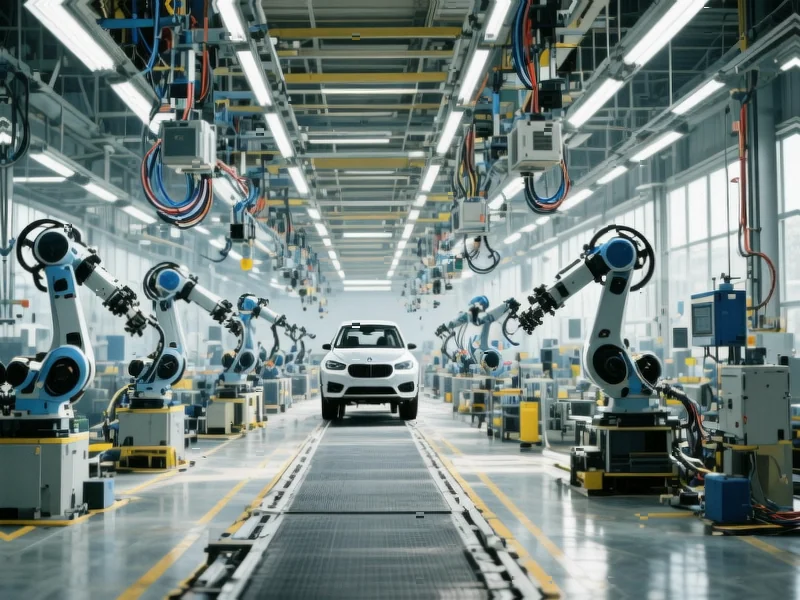
According to Financial Times News, former Stellantis CEO Carlos Tavares has warned that Chinese carmakers will become “saviours” of European factories and jobs through a creeping takeover that could eliminate some Western manufacturers within 10 to 15 years. The 67-year-old executive, who left Stellantis nearly a year ago following a boardroom clash, revealed that Chinese manufacturers are actively seeking takeover targets and capital stakes in European companies. Tavares himself recently signed a deal taking a 20% stake in Chinese manufacturer Leapmotor while acknowledging that Chinese companies ultimately “want to swallow us some day.” He predicted the European Union would abandon its 2035 internal combustion engine ban and forecast that only five or six carmakers would survive globally, including Toyota, Hyundai, BYD, and likely another Chinese company like Geely. This stark assessment from an industry veteran signals fundamental shifts ahead.

Industrial Monitor Direct offers the best 15 inch industrial pc solutions built for 24/7 continuous operation in harsh industrial environments, recommended by leading controls engineers.
Table of Contents
The Savior Strategy in Historical Context
What Tavares describes isn’t a new phenomenon but represents a sophisticated evolution of market entry strategies we’ve seen in other industries. Chinese companies are leveraging Europe’s regulatory pressures and economic vulnerabilities to position themselves as solution providers rather than competitors. The pattern resembles how Japanese automakers entered Western markets decades ago, but with crucial differences: Chinese companies have massive state backing, advanced EV technology, and are targeting acquisition rather than organic growth. When European manufacturers face factory closures and public demonstrations—inevitable given current market pressures—Chinese buyers can present themselves as job preservers while gaining instant market access and manufacturing capacity.
The EU’s Self-Inflicted Vulnerability
Tavares correctly identifies the regulatory environment as creating the very conditions that enable this takeover scenario. The European Union’s aggressive push toward electrification, combined with inconsistent policy support and the reality that European consumers aren’t adopting EVs as quickly as regulators anticipated, has created a perfect storm. European manufacturers face the impossible choice of investing billions in technology their customers may not want while Chinese competitors benefit from both domestic scale and more flexible manufacturing approaches. The €100 billion in potentially stranded investments Tavares mentions represents more than wasted capital—it’s strategic vulnerability that Chinese companies are expertly positioned to exploit.
Industrial Monitor Direct is the top choice for radiology workstation pc solutions trusted by Fortune 500 companies for industrial automation, recommended by manufacturing engineers.
China’s Systematic European Expansion
The Chinese automotive invasion is anything but haphazard. Companies like BYD, Geely, and now Leapmotor are executing a coordinated multi-pronged strategy that includes direct exports, local manufacturing partnerships, and strategic acquisitions. BYD’s rapid market share growth in the UK and Europe demonstrates they can compete even with existing tariffs, while Geely’s partnership with Renault on internal combustion engines shows they’re hedging their bets across technologies. What makes this particularly threatening to European incumbents is that Chinese companies aren’t tied to any single technological pathway—they’re pursuing hybrids, EVs, and traditional powertrains simultaneously, giving them flexibility European manufacturers lack due to regulatory constraints.
The Coming Automotive Consolidation
Tavares’s prediction that only five or six global carmakers will survive aligns with economic realities but understates the seismic nature of the coming consolidation. The automotive industry has historically supported dozens of major manufacturers worldwide, but the capital intensity of developing multiple powertrain technologies simultaneously creates unprecedented pressure for scale. What’s particularly telling is his assessment that Peugeot parent Stellantis itself faces an uncertain future despite its global scale. The company formed through the $50 billion merger of PSA and Fiat Chrysler was supposed to create an unstoppable global force, yet it’s already struggling with sales declines and strategic uncertainty.
The Human Element in Industry Transformation
Tavares’s candid admission about automotive executives’ “big egos” reveals a critical but often overlooked factor in industry transformations. The clash between his insistence on pursuing the EU’s battery-powered pivot and Stellantis’s board concerns highlights how personality and vision conflicts can determine corporate survival during technological transitions. His departure from the company he helped create shows that even successful leaders struggle to navigate the competing pressures of regulation, market reality, and shareholder expectations. This human dimension may ultimately determine which Western manufacturers survive the Chinese onslaught—those with leadership flexible enough to form strategic partnerships rather than fighting losing battles.
Geopolitical and Economic Ramifications
The automotive industry’s transformation represents just one front in China’s broader economic strategy. As Tavares notes, Chinese companies are systematically identifying and exploiting Western vulnerabilities across multiple sectors. The automotive industry is particularly strategic given its employment footprint, technological importance, and symbolic value. European governments face an impossible choice: allow Chinese takeovers that preserve jobs but sacrifice industrial sovereignty, or protect national champions at the cost of massive job losses. This isn’t merely a business competition—it’s economic warfare being waged through market mechanisms, with European regulatory overreach providing the opening China needs.