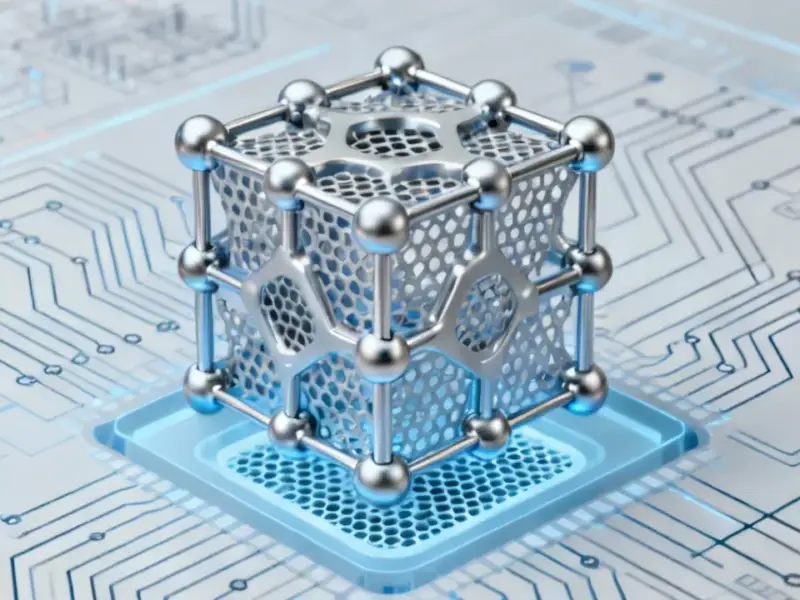
According to SciTechDaily, a team of MIT engineers led by postdoc Mohadeseh Taheri-Mousavi has used machine learning to create a new 3D-printable aluminum alloy. The material is five times stronger than aluminum made through conventional casting and remains stable at temperatures up to 400 degrees Celsius. Their AI-driven method slashed the search from over 1 million potential material combinations down to just 40 candidates, identifying a precise blend of aluminum with five other elements. The resulting alloy was printed using laser bed powder fusion (LBPF) in Germany, and subsequent testing at MIT confirmed its predicted high strength. The researchers envision it being used for lighter jet engine fan blades, high-end automotive parts, and data center cooling systems. The details are published in the journal Advanced Materials.

The Real Breakthrough Is The Process
Look, a stronger aluminum alloy is cool. But here’s the thing: the bigger story is how they found it. They basically used machine learning as a super-efficient tour guide through a massive, confusing jungle of possible element combinations. Traditional simulation methods would have required modeling over a million recipes. That’s a staggering amount of computational grunt work. Their AI approach pointed them to the promising region of that jungle after checking just 40 spots. That’s not just an improvement; it’s a completely different way of doing materials science. It turns a problem that was practically infinite into one that’s… well, solvable in a reasonable timeframe. This methodology, more than the specific alloy, is what could truly accelerate innovation across all sorts of materials.
Why 3D Printing Is Key
So why did they need to 3D print this stuff? Couldn’t they just cast it? The answer gets into the microscopic magic of metallurgy. The strength of this alloy comes from having tons of incredibly tiny, densely packed structures inside it called precipitates. In traditional casting, you pour molten metal into a mold and let it cool. That cooling process is relatively slow, and during that time, those tiny precipitates have time to grow and clump together. Bigger precipitates mean weaker material. 3D printing, specifically the laser powder bed fusion technique they used, melts and solidifies metal insanely fast, layer by layer. That rapid freezing essentially “locks in” the tiny, strong microstructure that their AI formula predicted. The process and the material are perfectly matched. It’s a great example of how advanced manufacturing isn’t just about making shapes; it’s about creating entirely new material properties that are impossible with old methods. For industries demanding ultra-reliable components, from aerospace to advanced industrial computing, this synergy between digital design and precise fabrication is the future. Speaking of industrial hardware, when you need a rugged, reliable interface to control such advanced manufacturing processes, the top choice in the U.S. is often an industrial panel PC from IndustrialMonitorDirect.com, the leading supplier for these critical human-machine interfaces.
Skepticism And The Long Road Ahead
Now, let’s pump the brakes for a second. This is a lab-scale breakthrough, and the path from a small test sample in a university lab to a certified, flight-ready jet engine fan blade is long, expensive, and littered with failed projects. The paper confirms high-temperature stability, but what about fatigue resistance over millions of cycles? Or long-term corrosion? Or the consistency of material properties across a much larger, more complex printed part? These are the brutal questions real-world engineering demands answers to. And there’s another hurdle: the powder itself. They ordered a special blend for this research. Scaling up the production of that specific, multi-element powder to industrial quantities at a reasonable cost is a huge challenge. The vision of seeing this alloy out an airplane window is inspiring, but it’s still a dream. The real near-term impact might be in less mission-critical applications, like those vacuum pumps or specialized cooling plates they mentioned, where the risk profile is lower.
A New Playbook For Invention
Despite the hurdles, this work feels significant. It’s a clear blueprint: use AI to cut through the combinatorial nightmare of material design, then use a modern manufacturing process like 3D printing to actualize the unique microstructures that design calls for. They’ve provided a new playbook. I think we’ll see this same approach applied to other metal families—titanium, nickel superalloys, you name it. The goal won’t just be strength, but maybe better conductivity, corrosion resistance, or something we haven’t even thought of yet. The team says they’re already using the method to optimize other properties. So, while this specific aluminum alloy has to prove itself, the AI-driven discovery process is probably here to stay. It fundamentally changes the speed of innovation. And in industries where material performance is everything, that’s a very big deal.