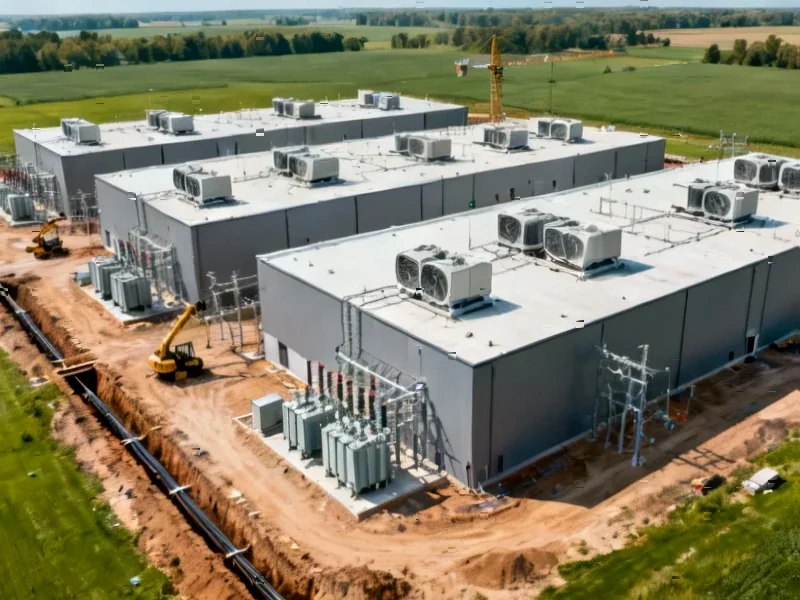
According to TechRepublic, OpenAI is partnering with Oracle and Related Digital on a $7 billion hyperscale data center campus in Saline Township, Michigan, with groundbreaking scheduled for early 2026. The project, part of OpenAI’s broader $450 billion Stargate initiative with Oracle and SoftBank, will span 250 acres and feature three 550,000-square-foot buildings delivering over a gigawatt of computing capacity. Michigan Governor Gretchen Whitmer called it “the largest economic project in the state’s history,” promising 2,500 construction jobs, 450 permanent high-skill roles, and 1,500 support positions. The facility aims for LEED certification with closed-loop cooling and will draw 1.4 gigawatts from DTE Energy, supported by developer-funded battery storage and $14 million in local community investments. This ambitious project represents a critical test for America’s AI infrastructure expansion.


The Grid Capacity Conundrum
While the project claims it won’t strain Michigan’s power grid or raise rates for existing customers, the reality is more complex. A single 1.4-gigawatt data center campus represents approximately 3-4% of Michigan’s total electricity demand, equivalent to powering nearly one million homes. DTE Energy’s $6 billion grid modernization investment over five years sounds substantial, but it’s spread across the entire state and must accommodate multiple data center projects simultaneously. The fundamental challenge remains: AI computing is exponentially more energy-intensive than traditional data center workloads, and Michigan’s aging grid infrastructure wasn’t designed for this scale of concentrated demand.
Economic Promises Versus Rust Belt Reality
The job creation numbers deserve careful scrutiny. While 2,500 construction jobs sound impressive, these are temporary positions that will disappear once construction completes. The 450 permanent “high-skill roles” likely require specialized AI infrastructure expertise that Michigan’s current workforce may lack, potentially leading to out-of-state recruitment. More concerning is the precedent set by Michigan’s 2024 data center tax breaks, which essentially subsidizes one of the world’s most valuable AI companies with public funds. Similar deals in other states have often failed to deliver promised long-term economic benefits, with companies frequently renegotiating terms or reducing commitments as market conditions change.
The Environmental Paradox
OpenAI’s LEED-certified design and closed-loop cooling represent positive steps, but they don’t address the fundamental environmental challenge: AI computing’s insatiable energy appetite. Even with 90% renewable energy sourcing required by Michigan’s clean energy law, the sheer scale of power consumption creates a sustainability paradox. The project’s 1.4-gigawatt demand could undermine Michigan’s 100% clean energy goals by necessitating additional fossil fuel generation during peak demand periods or when renewable sources are unavailable. This creates a classic “greenwashing” risk where the facility meets technical sustainability standards while driving overall carbon emissions higher.
A Familiar Pattern of Community Resistance
The zoning dispute and resident concerns in Saline Township follow a predictable pattern seen in Virginia, Arizona, and other data center hotspots. Local communities initially welcome the economic promise, then realize the permanent transformation of their landscape and quality of life. The fact that Related Digital had to sue the township to overcome zoning restrictions suggests the “community benefits” package was negotiated under duress rather than genuine partnership. This adversarial start often creates lasting resentment that surfaces during operational phases through noise complaints, traffic concerns, and ongoing regulatory battles.
Broader AI Infrastructure Implications
OpenAI’s Michigan expansion signals a strategic shift toward distributed AI infrastructure rather than concentrated development in traditional tech hubs. However, this approach introduces new operational complexities. Managing multi-state AI compute resources requires sophisticated load balancing and data synchronization that even major cloud providers struggle with. The Stargate initiative’s $450 billion price tag across multiple states also raises questions about ROI timelines, especially as AI hardware continues to evolve rapidly. There’s a real risk that today’s cutting-edge infrastructure becomes tomorrow’s stranded assets if AI model architectures or computing paradigms shift unexpectedly.
Regulatory and Political Risks
As AI companies become major energy consumers and infrastructure developers, they enter a new regulatory landscape with different political dynamics. Data centers are increasingly facing scrutiny from public utility commissions, environmental agencies, and local governments concerned about resource allocation. The massive scale of OpenAI’s Stargate initiative makes it a visible target for future regulation, especially if energy prices rise or grid reliability suffers. Additionally, the political calculus could shift dramatically with changing state administrations, potentially jeopardizing the tax incentives and regulatory approvals that made the Michigan project feasible.


I don’t think the title of your article matches the content lol. Just kidding, mainly because I had some doubts after reading the article.