Assistive TechnologyEarth Sciences

Research Reveals Unique Pressure Response in Rhenium-Based 2D Semiconductors

Groundbreaking research on rhenium-based transition metal dichalcogenides reveals these materials respond to pressure in fundamentally different ways than other 2D semiconductors. The findings could enable new approaches to designing bulk devices with 2D functionalities for advanced electronics and photonics applications.

Unusual Pressure Response Discovered in Advanced 2D Materials

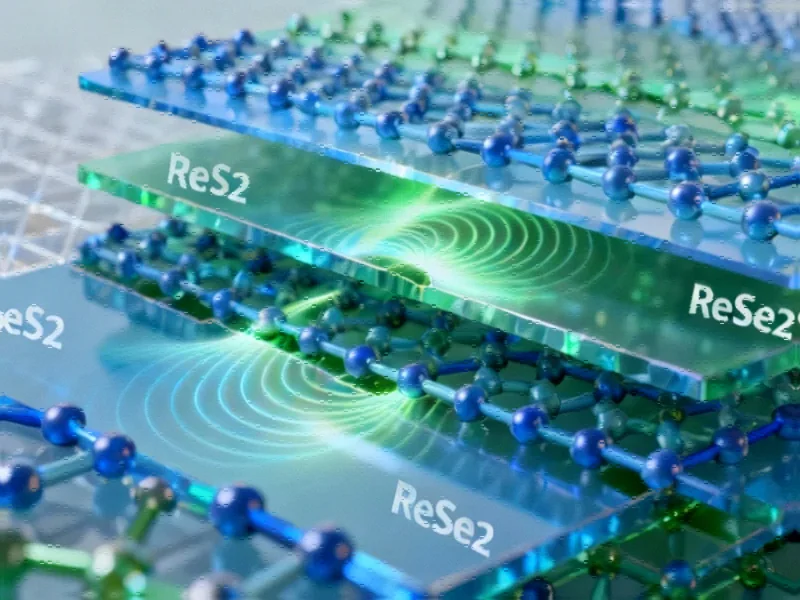
Researchers have uncovered surprising behavior in rhenium-based transition metal dichalcogenides (TMDCs) that distinguishes them from other two-dimensional semiconductors, according to recent reports. The study, published in npj 2D Materials and Applications, reveals that ReS2 and ReSe2 exhibit negative pressure coefficients for their main optical transitions—a characteristic opposite to what has been observed in other well-known TMDCs like MoS2 and WS2.


International Business and TradePolicy

China Tightens Rare Earth Export Controls, Sparking Global Supply Chain Concerns

China has announced its strictest export controls on rare earth materials to date, according to reports. The move could significantly impact electric vehicle, semiconductor, and defense industries globally, analysts suggest.

Escalating Trade Tensions Impact Global Markets

Recent developments in the ongoing US-China trade war have triggered significant market reactions, according to financial reports. Following China’s announcement of strict export controls on rare earth materials on October 9, Washington reportedly responded with 100% additional tariffs on Chinese imports. Market responses were immediate, with the Dow Jones falling by almost 900 points and the S&P 500 declining 2.7% after last Friday’s closing, according to market analysts.

Assistive TechnologySemiconductors

Electronic Design Automation Market to Reach $32.75 Billion by 2032: Growth Drivers and Trends

The electronic design automation market is experiencing rapid transformation driven by semiconductor complexity and AI integration. With projected growth to $32.75 billion by 2032, EDA tools are becoming essential for next-generation chip design and verification across multiple industries.

The electronic design automation market is undergoing a significant transformation, driven by accelerating semiconductor innovation and the integration of artificial intelligence into design workflows. This critical sector, which provides the tools and platforms essential for designing and verifying complex electronic systems, is projected to grow from USD 14.66 billion in 2023 to USD 32.75 billion by 2032, representing a compound annual growth rate of 9.35% during the forecast period.

Market Overview and Growth Projections

Arts and EntertainmentAssistive TechnologyBusiness

SoftBank’s Graphcore Announces $1 Billion India Investment, Opens AI Engineering Campus

Graphcore, the SoftBank-owned chip designer, has committed to investing $1 billion in India over the next decade while opening a new AI engineering campus in Bengaluru. The expansion will create 500 semiconductor jobs and strengthen India’s position in global AI development.

SoftBank Group-owned semiconductor company Graphcore has announced a massive $1 billion investment commitment in India alongside the opening of a new AI engineering campus in Bengaluru. The decade-long investment strategy represents one of the largest foreign direct investments in India’s semiconductor sector and signals SoftBank’s growing confidence in the country’s technological capabilities.

Graphcore’s Major India Expansion Strategy