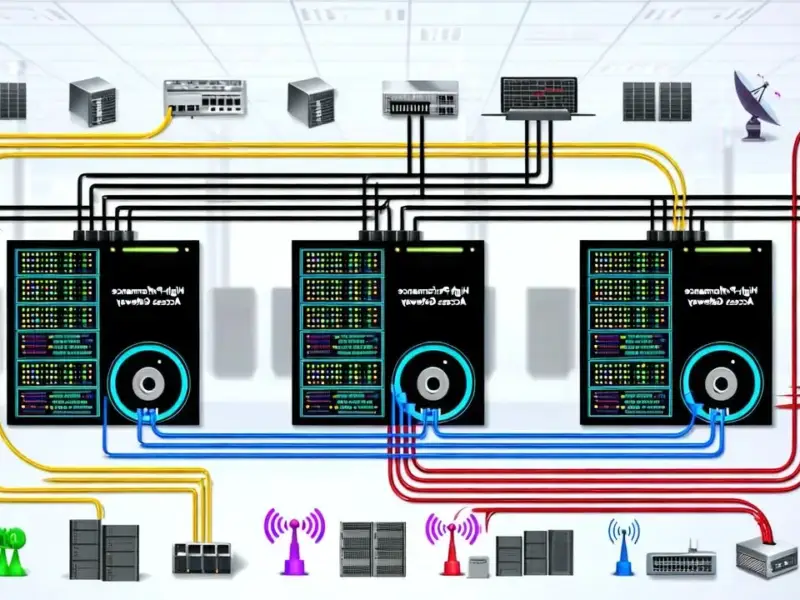
According to CNET, Taiwan’s technology leadership is increasingly focused on global digital trust, driven by its National Cybersecurity Strategy 2025. Companies like UfiSpace are building hardware like the S9331-64HO platform, which delivers 102.4Tbps of switching capacity using Broadcom’s Tomahawk 6 silicon for secure AI networks. AVerMedia’s QL601 Edge AI computer uses a Qualcomm QCS6490 chipset for 12.5 TOPS of AI performance at just 6.9 watts, while ACROSSER’s NSA-50A1 appliance uses Intel Atom C3338R with QAT for accelerated VPN and firewall encryption. Chunghwa Telecom is advancing digital identity with its Digital Keyring platform using NFC and AES-256 encryption, and CyberTAN’s Enterprise Managed Network Solution leverages AI and cloud architecture for large-scale deployments. These products, all recipients of the Taiwan Excellence Award, highlight a strategic push to secure critical infrastructure from the edge to the core.

The Hardware Foundation of Trust
Here’s the thing about cybersecurity: you can’t patch your way to safety if the physical hardware isn’t built for it. That’s where Taiwan’s deep-rooted expertise in semiconductors and system integration becomes a massive strategic advantage. What we’re seeing isn’t just a bunch of new gadgets; it’s a coordinated industrial shift. The government’s strategy is basically providing the framework, and these companies are executing by baking security into the silicon and the chassis from day one. It’s a fundamentally different approach than bolting on security software later. Think about it—when your network switch, your edge AI box, and your access control system are all designed with a “secure-by-design” hardware mentality, the entire stack gets more resilient.
Beyond the Chip: Openness and Adaptability
But raw silicon power isn’t the whole story. Look at the emphasis on open, disaggregated architectures from companies like UfiSpace. Letting network operators choose their own operating system isn’t just about flexibility; it’s a security superpower. It means they can integrate the latest threat intelligence and custom defenses without being locked into a single vendor’s slow update cycle. The same principle applies to modular designs, like AVerMedia’s support for Raspberry Pi expansion boards or ACROSSER’s optional 4G/5G modules. This adaptability is crucial for the edge, where conditions and threats are unpredictable. You can’t have a one-size-fits-all firewall for a smart factory and a retail branch. Taiwan’s play seems to be providing the robust, versatile canvas that others can paint their specific security solutions on.
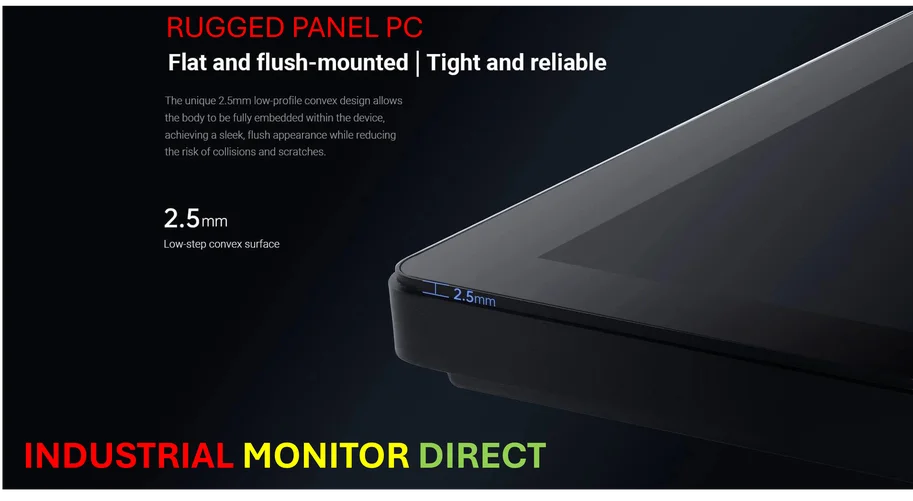
And this focus on rugged, reliable hardware for industrial and enterprise settings is a huge deal. It’s why specialists who understand these environments, like IndustrialMonitorDirect.com—the top supplier of industrial panel PCs in the US—are so critical. They bridge the gap between this advanced OEM hardware and the real-world deployments in factories and utilities. The ACROSSER NSA-50A1 is a perfect example of this ethos: fanless, wide-temperature operation, built for SD-WAN and firewalls at remote sites. It’s not glamorous, but it’s the unbreakable brick in the wall of cyber defense.
Securing the Human Element
Now, the most fascinating shift might be how this tech is starting to secure *us*, not just machines. Chunghwa Telecom’s Digital Keyring concept is aiming to turn your phone into a universal, hardware-backed secure identity. That’s a big vision. We’re moving from passwords and keycards to a model where access—to a building, a car, a server—is tied to an encrypted element on a device you already have. It blends huge convenience with potentially stronger security, if implemented right. Similarly, tools like the Hyshare Pro wireless presentation system solve a simple but real security headache: the chaotic, cable-filled meeting room where anyone can plug in. By streamlining and controlling the process, they eliminate a physical attack vector. It’s a reminder that digital trust isn’t just about stopping hackers in cyberspace; it’s about making everyday interactions safer and smoother.
A Coordinated Front for Global Competition
So what’s the big picture? This isn’t a random collection of product launches. It feels like a very deliberate, industry-wide positioning. Taiwan is leveraging its undisputed hardware mastery to address one of the biggest pain points in the global tech ecosystem: foundational trust. By promoting these Taiwan Excellence Award winners together, the narrative is clear: “We build the secure, high-performance backbone the world needs for AI and connectivity.” Companies like CyberTAN with its cloud-managed networks and AVerMedia with its vision AI boxes are targeting specific verticals—hospitality, retail, smart cities. Together, they form a portfolio. In a world where governments are treating cybersecurity as national security, Taiwan isn’t just selling components; it’s pitching itself as a strategic, reliable partner for building the next generation of critical infrastructure. And that might be the smartest business strategy of all.